No API bill, ever
Overture Maps is open data. Grezzio reads it directly from the public dataset, so a list of 3,000 hairdressers in Zuid-Holland costs the same as a list of ten: nothing.
 Buy — €99 once
Grezzio 8.6.1 · Windows · 16 languages
Grezzio finds the companies, verifies every address, checks the recipient's market against its own statute, and only then sends. What comes back lands in the program too.
No subscription · no cloud account · your own AI key
53 markets · 53 rulings
Allowed 3 Conditional 16 Opt-in 34
Opt-in also towards companies. Soft opt-in only for existing customers, for similar goods or services.
Telecommunicatiewet, art. 11.7 · DLA Piper, Data Protection Laws of the World · checked 2026-08
Grezzio's home market is red. That is exactly why you can trust it when it says green somewhere else — the Dutch rules are not softened because the program is sold from a Dutch domain.
01 / Discovery
Type a place and a trade. Grezzio reads the open Overture Maps business dataset and hands you the companies that actually have an address you can write to — no scraper, no Google bill, no monthly credits.
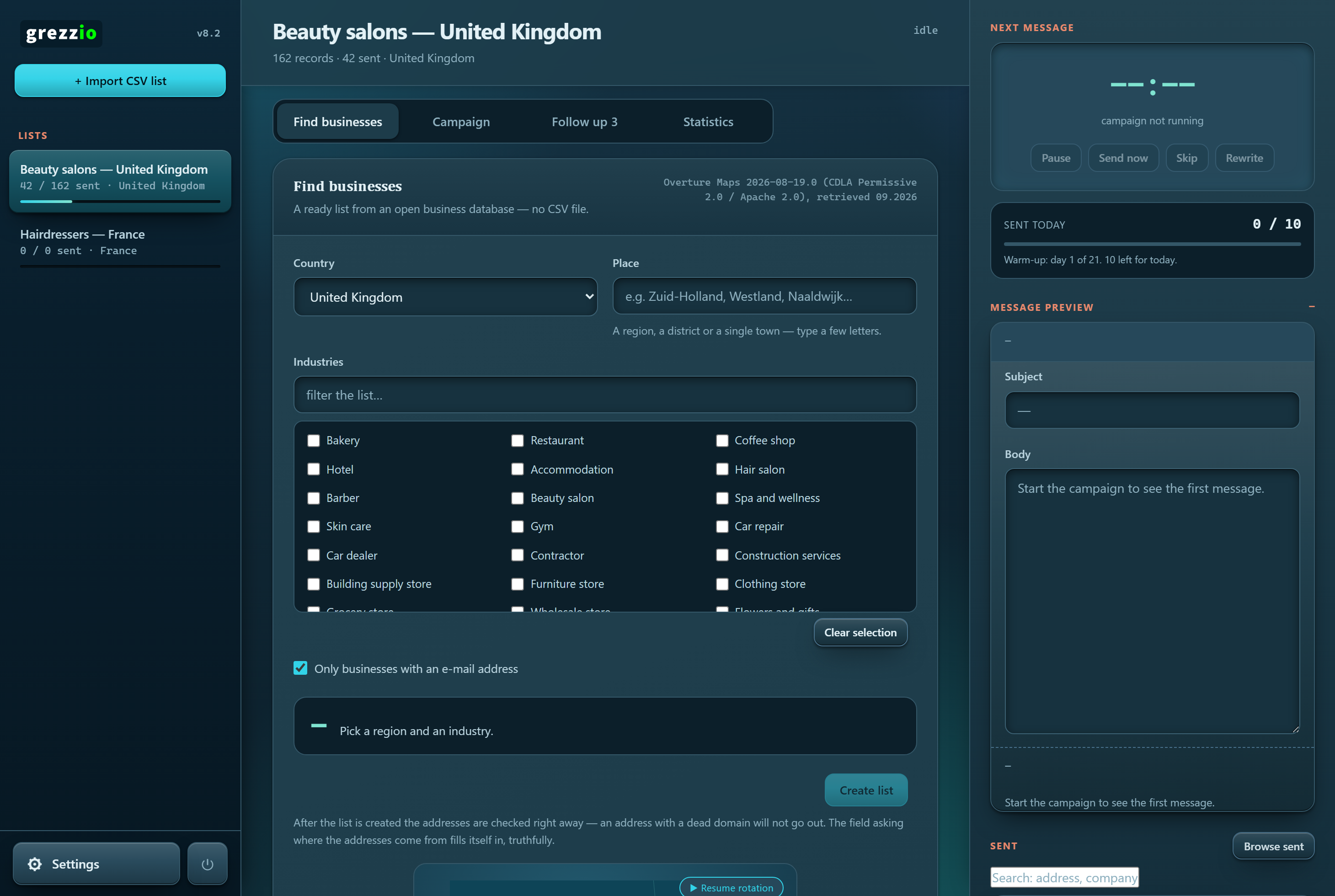
The real Find businesses screen. The globe zooms to the country you pick.
Overture Maps is open data. Grezzio reads it directly from the public dataset, so a list of 3,000 hairdressers in Zuid-Holland costs the same as a list of ten: nothing.
Import will not proceed without a “where these addresses come from” field. It is the first thing a supervisory authority asks for, and the last thing anyone remembers a year later.
When the dataset changes, Grezzio picks up the new release on its own. In September 2026 the supplier removed the column Grezzio filtered on; the program asks the data which column exists instead of trusting a calendar, so that change passed without a new installer.
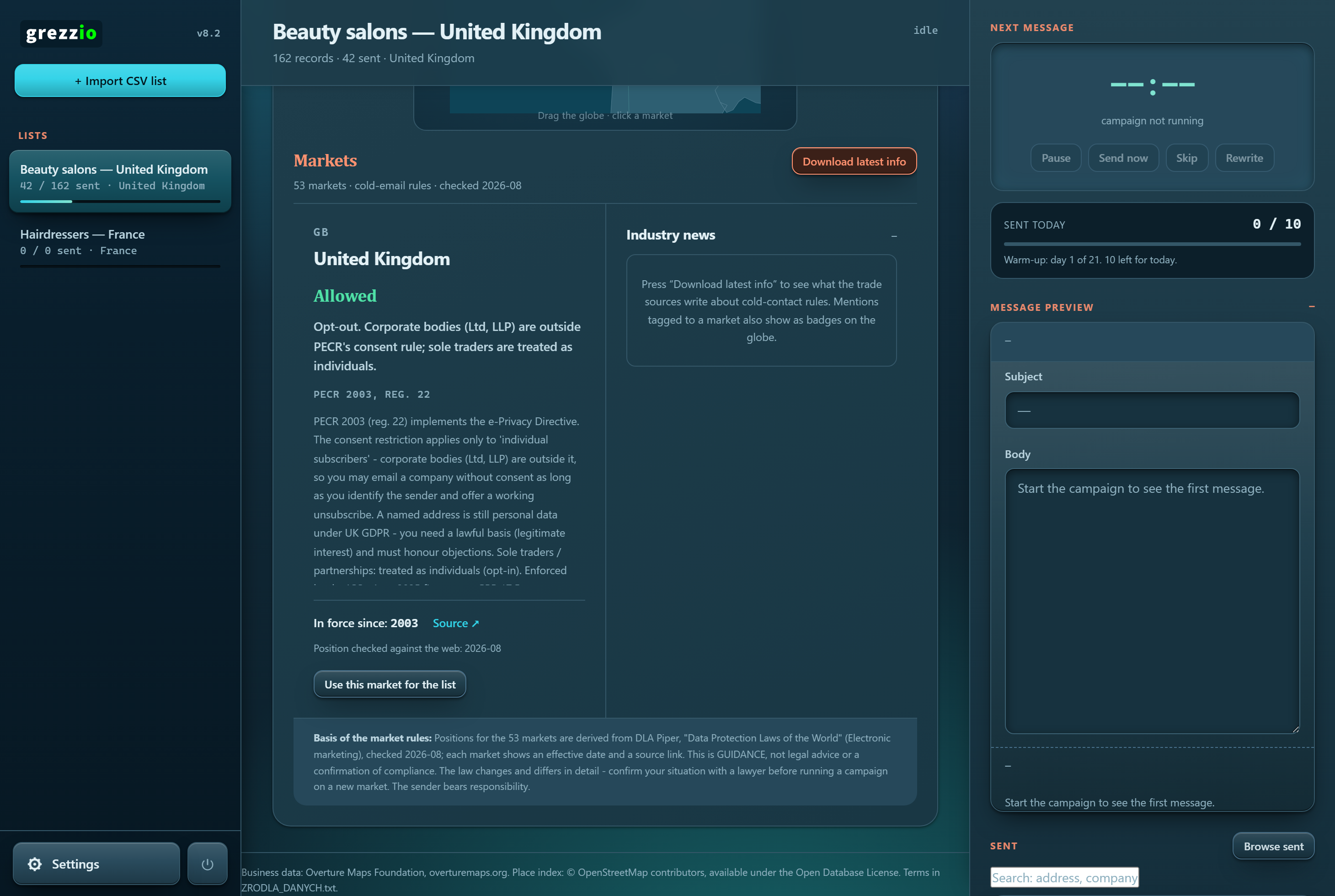
The rules of the market you picked and the trade news about it, side by side. Until 8.1 one hid the other.
02 / Compliance
Every recipient is measured against their own market's rule the moment the list is loaded — not after a complaint lands. Grezzio calls it the compliance signal, and it decides which addresses ever reach the queue.
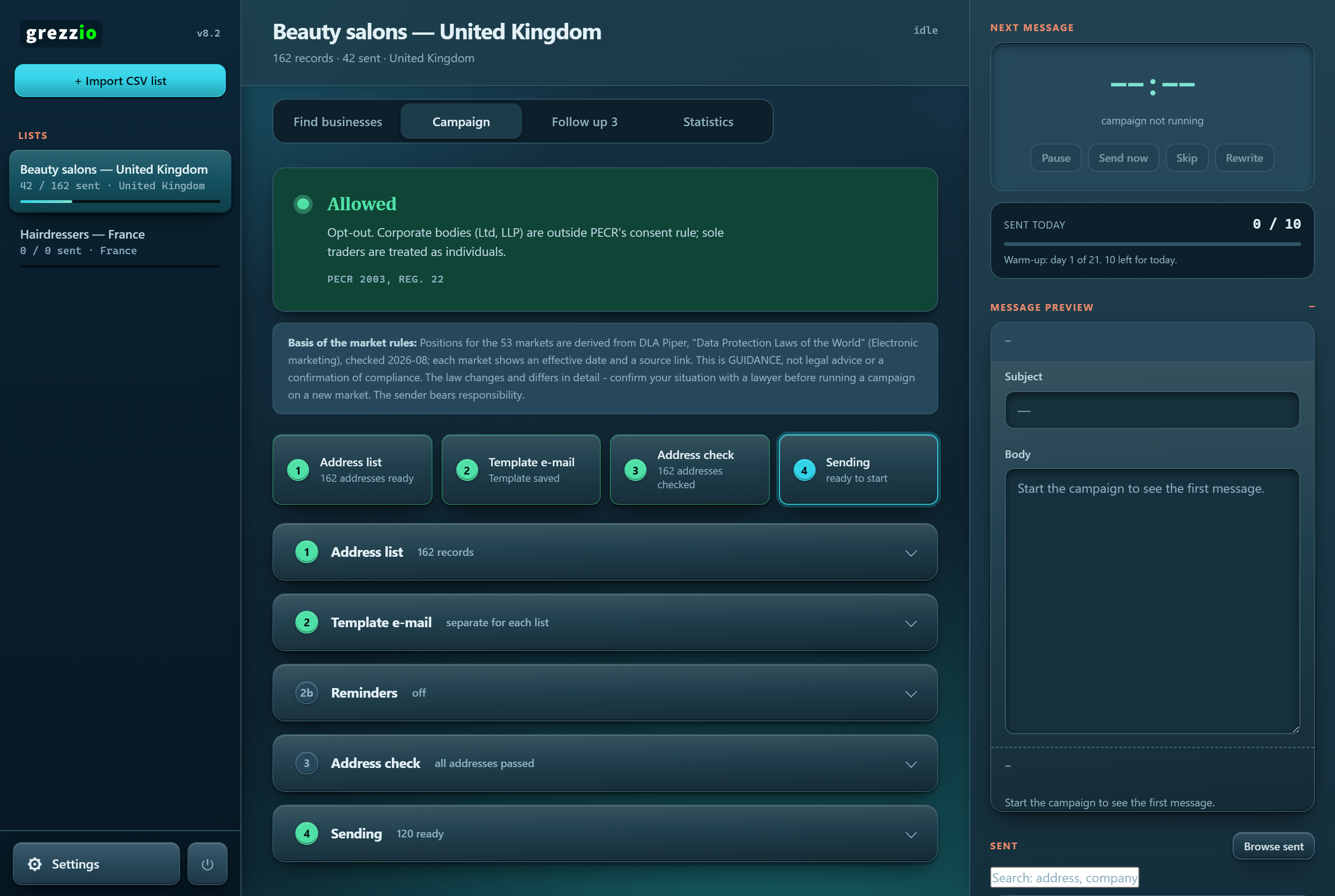
The Campaign tab: four steps and the compliance signal for the market you are writing to.
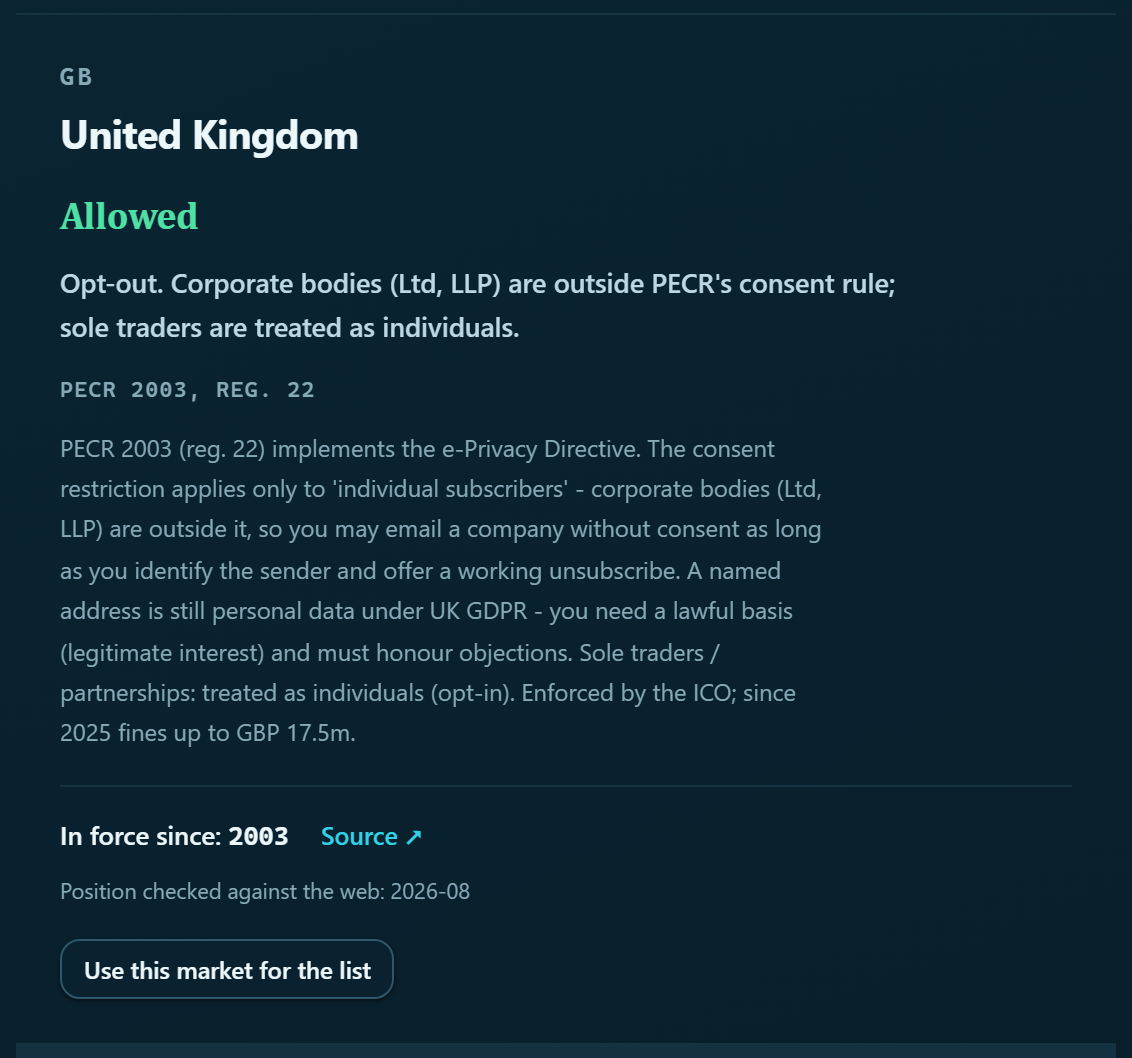
United Kingdom — an opt-out market under PECR 2003, reg. 22.
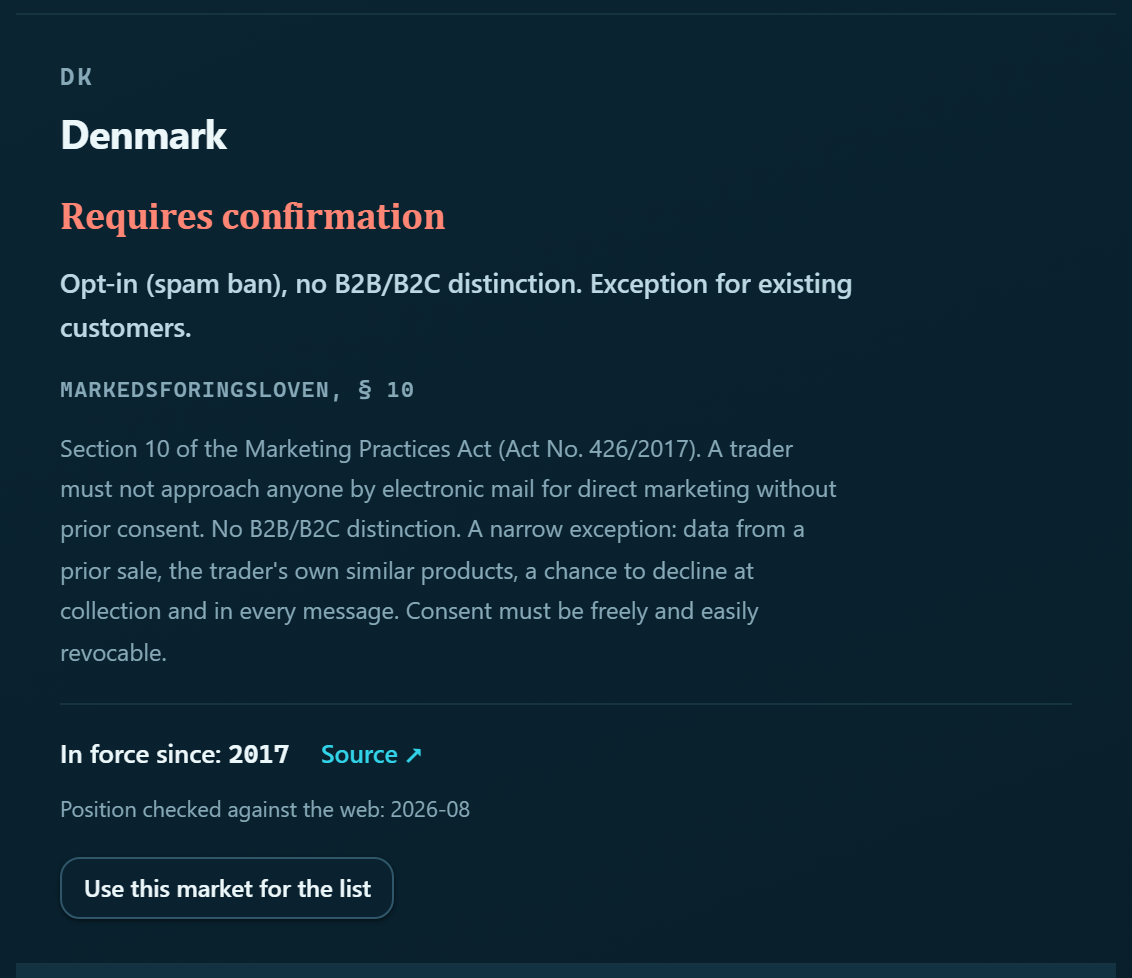
Denmark — opt-in under Markedsføringsloven § 10. Sending is blocked until confirmed.
This is guidance, not legal advice. Grezzio reflects a publicly available legal survey — DLA Piper, “Data Protection Laws of the World” (Electronic marketing), checked 2026-08 — with the source and date shown for every market. Laws change and differ in detail. Confirm your situation with a lawyer before a campaign in a new market. Responsibility for sending stays with the sender.
03 / Follow up New in 8.0
Until now Grezzio remembered what it sent. From 8.0 it keeps the whole conversation: your message, their answer, your reminder, their answer. One company, one thread, in the order it happened.
What you wrote, exactly as it went out.
Fetched from your own mailbox and stored in full. The quoted copy of your own message is trimmed off.
Goes out as a reply inside the same thread, so in the recipient's mailbox it sits with the first message.
The empty slot is shown too. That is the question this tab answers: did anyone get back to you.
The last one there will ever be. A third attempt is not offered, by design.
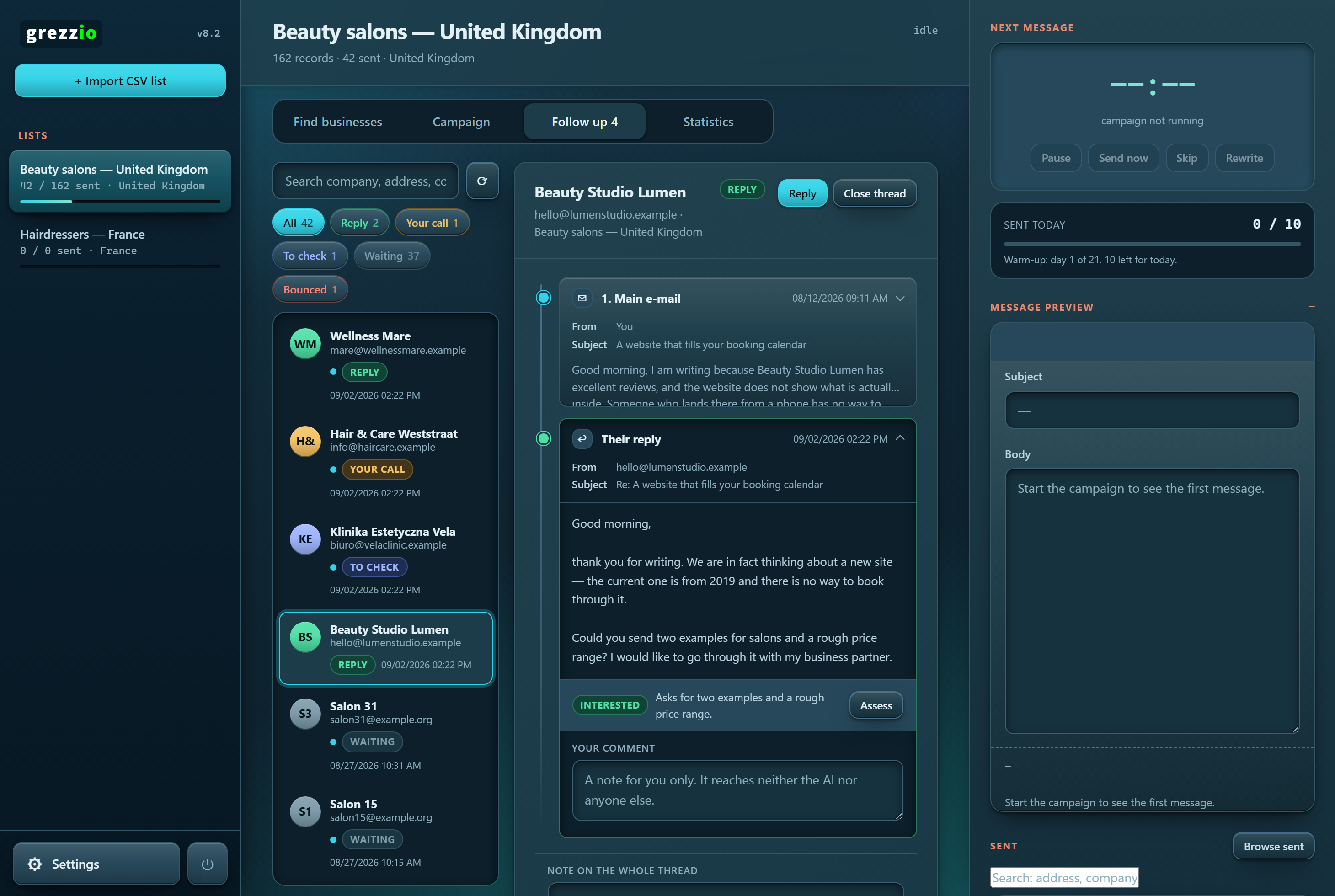
The Follow up tab: threads on the left, the conversation on the right. Clicking a message opens it in full.
Every incoming reply is described in one of six ways and summarised in a single sentence. It is a description of the content, not sales advice: the program does not tell you whether something is worth your time.
“No, thank you” ends a conversation. “Please delete my data” is a request with legal effect. Grezzio keeps them apart on purpose, and routes the second one where opt-outs go.
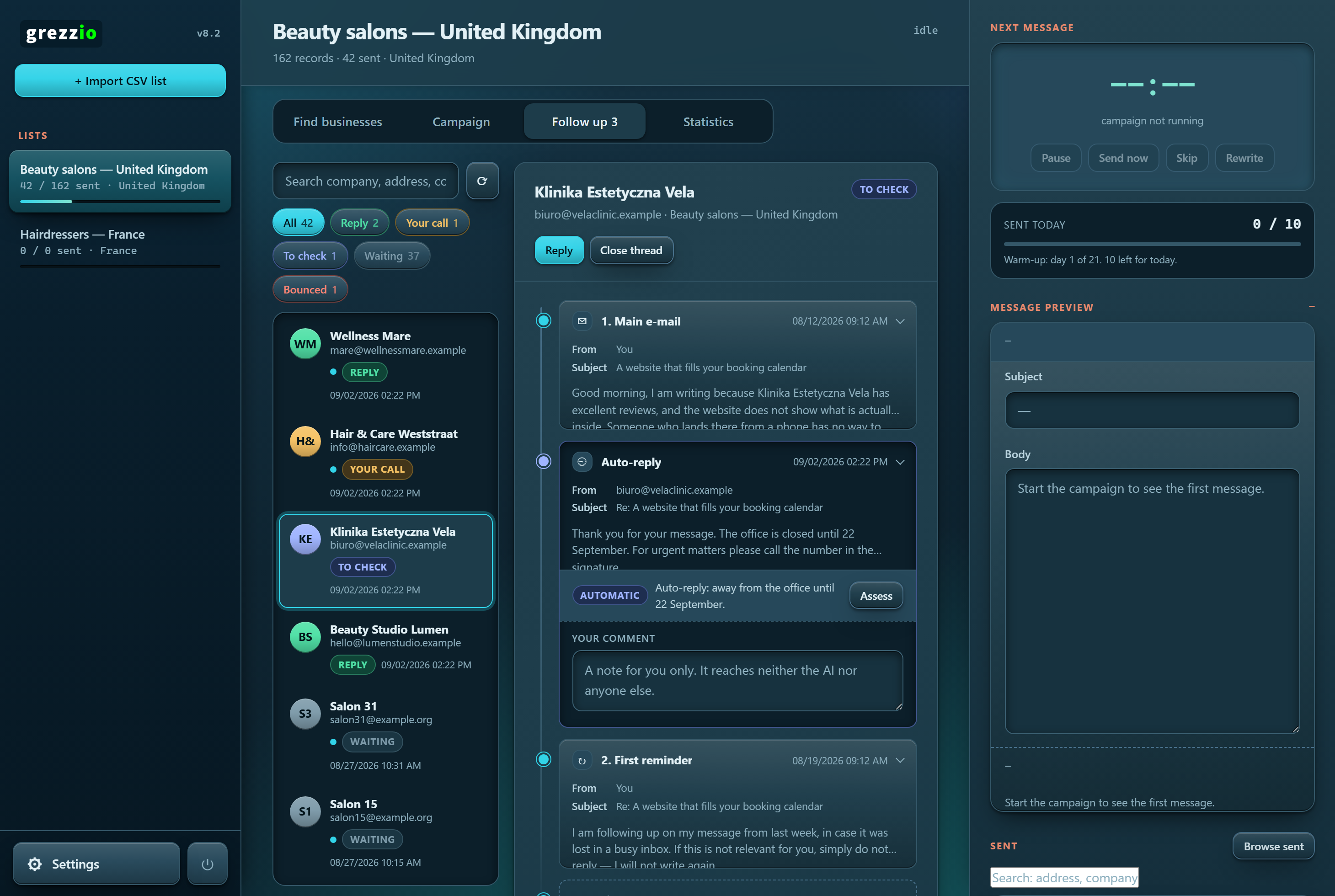
An auto-reply is visible but never counted as a reply. The thread turns blue: come back to this one later.
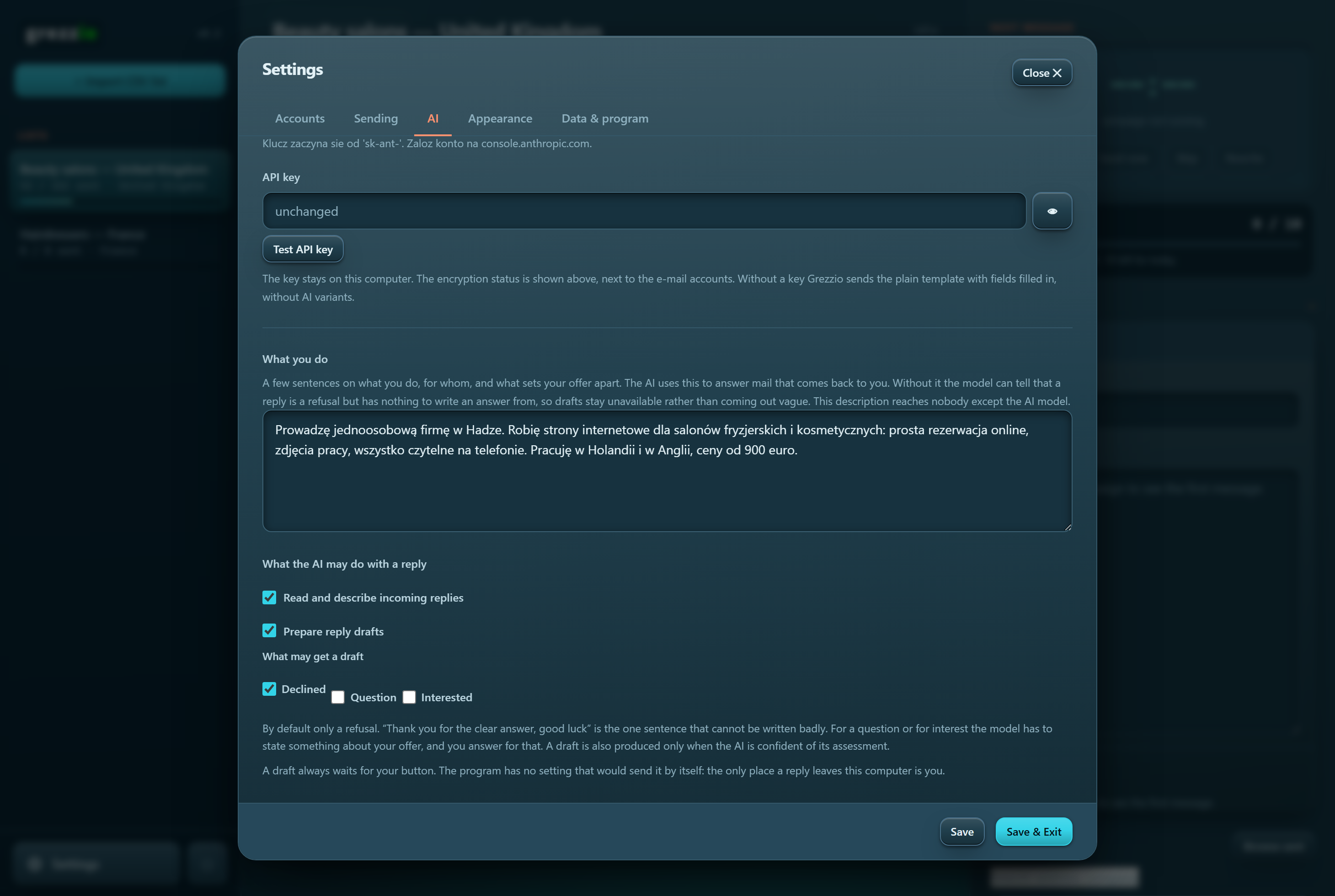
Settings · AI. A few sentences about what you do. Without them drafts stay unavailable rather than coming out vague.
A draft sits in the thread and waits for a button. By default the AI may answer only a refusal, because “thank you for the clear answer, good luck” is the one sentence that cannot be written badly. Questions and interest can be switched on, but then the model has to state something about your offer — and you answer for that.
A draft is produced only when the model is confident of its own reading. At low confidence you get nothing, because a bad draft is worse than no draft: you read the ready-made text instead of the reply itself.
Every incoming message has a comment field, and each thread has one of its own. Neither leaves the machine and neither reaches the AI. It is a notebook, not material for a model.
Reminders are a setting of the list, not of the program — every campaign has its own rhythm. Off by default, five days by default, one reminder by default.
Two is the hard maximum and cannot be raised, from the window or anywhere else. The legal basis for cold outreach is legitimate interest, and its weight falls with every unanswered message. Silence is not consent. At a third attempt the argument stops holding, so the program does not offer one.
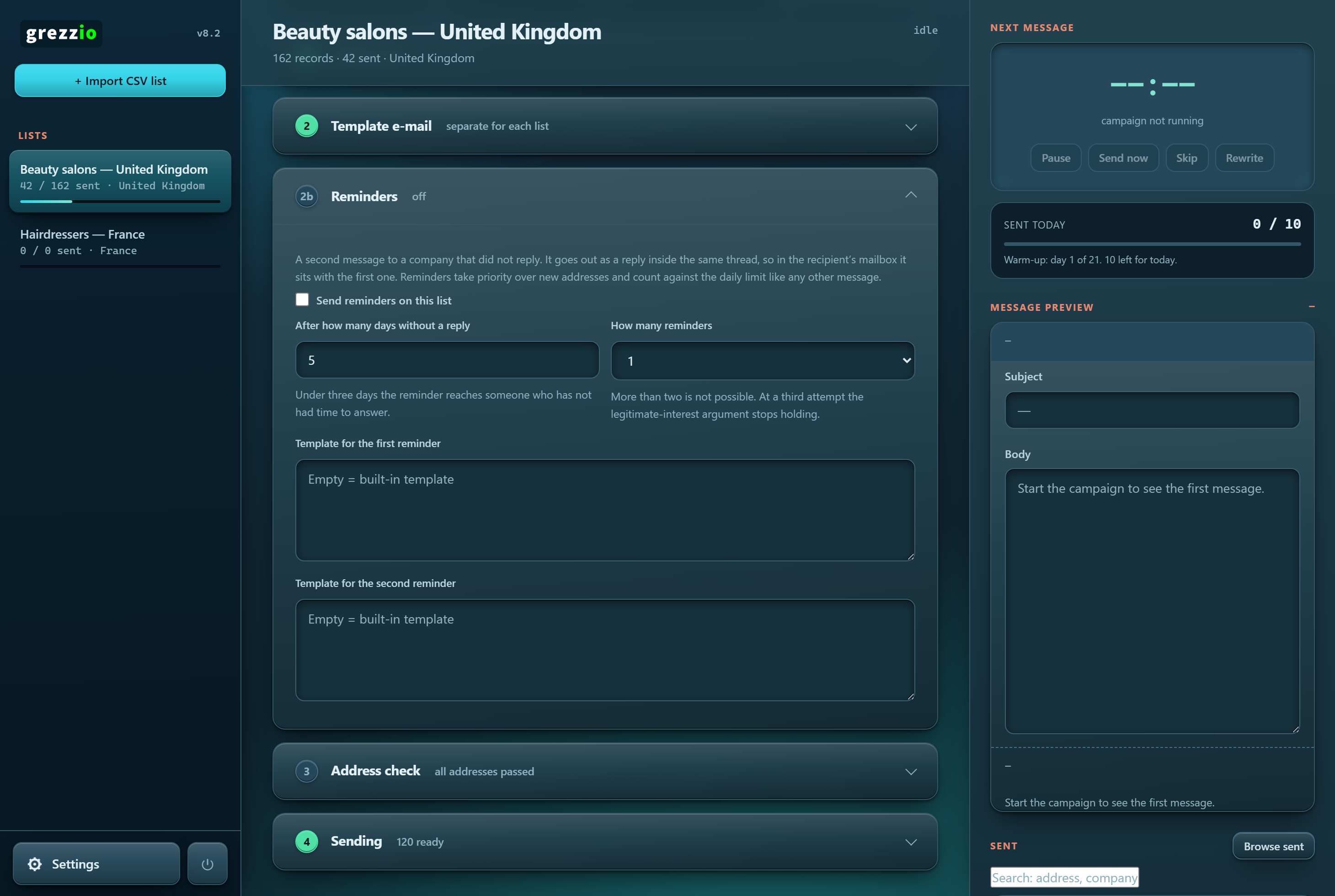
Reminders are configured per list, and the program says what the volume will actually be before you switch them on.
04 / Delivery
Getting permission right is half of it. The other half is arriving in an inbox instead of a spam folder — which is a question of pace, hygiene, and knowing when to stop.
Syntax, throwaway domains, whether the domain resolves and whether it accepts mail at all. A dead address never becomes a bounce, and a bounce never becomes a reputation problem.
10 a day, then 20, 30, 40, 50. A brand-new mailbox that sends 400 messages on its first morning is the fastest way to get a domain blocked, so Grezzio simply will not do it.
If the bounce rate crosses the threshold over a meaningful sample, the campaign pauses on its own. A daily budget per mailbox holds the line even when you forget.
A random gap between messages, a pause after a set count, sending confined to business hours. Configurable, and on by default.
Grezzio stamps every message with its own identifier and threads the reminder to it. A bare “Re:” in the subject with no threading headers is a separate e-mail pretending to be a reply. This program does not do that.
Add a second mailbox on the same domain and Grezzio says so: reputation is measured per domain, so two mailboxes are one reputation loaded twice, not two.
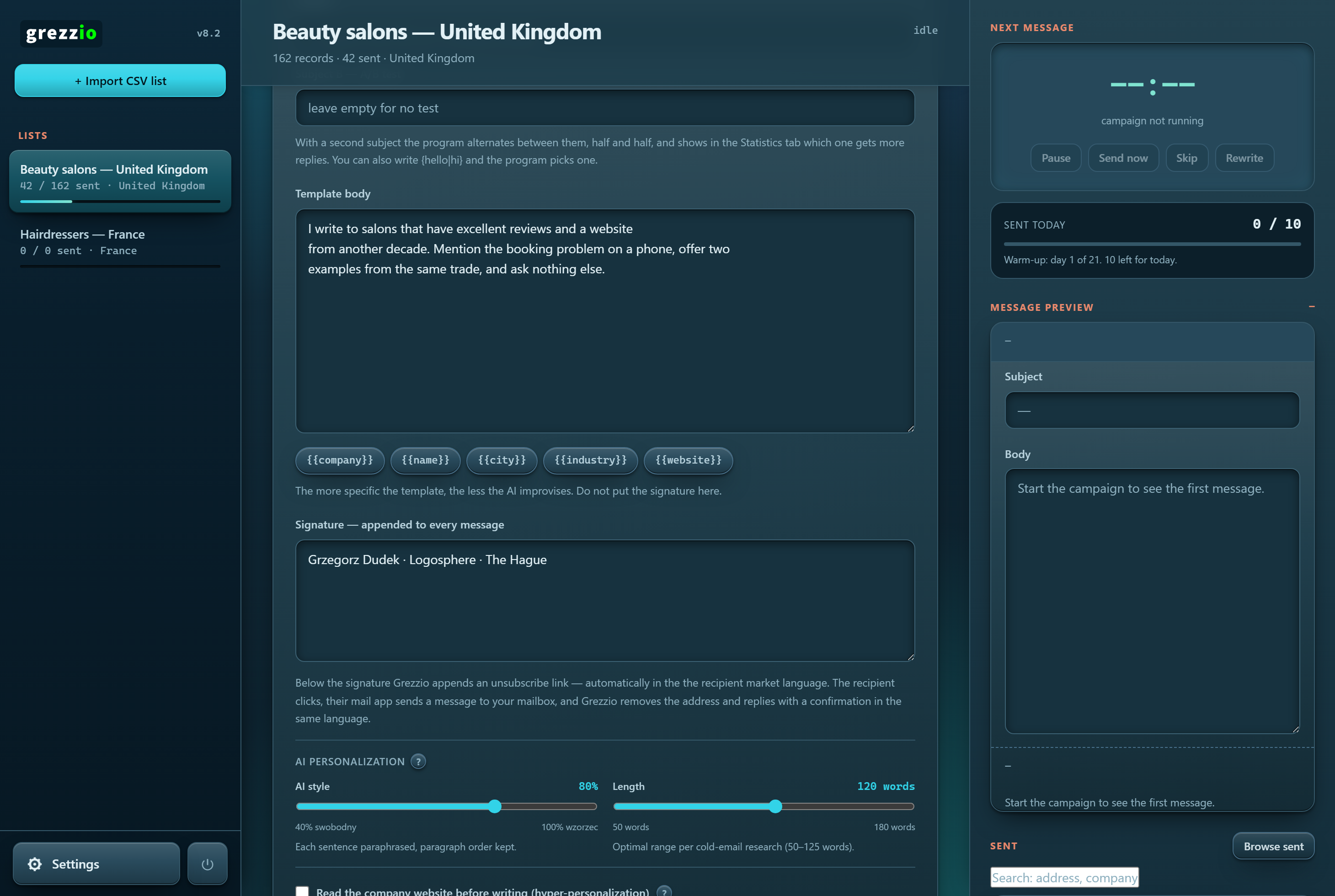
One template, a shared signature, a style slider and a length slider.
Bring your own key for Anthropic, OpenAI or Google and each message is written around the company in front of it. The request goes from your machine straight to the provider — never through us, because there is no “us” in the path.
No key is a valid answer too. Grezzio sends the plain template rather than sending nothing, and a test to yourself takes the full path first, with the real footer and the real unsubscribe link.
Replies, bounces, opt-outs, how long an answer takes, and — new in 8.0 — the reply rate broken down by attempt. That last table is the only way to tell whether reminders are earning their place or only raising complaints.
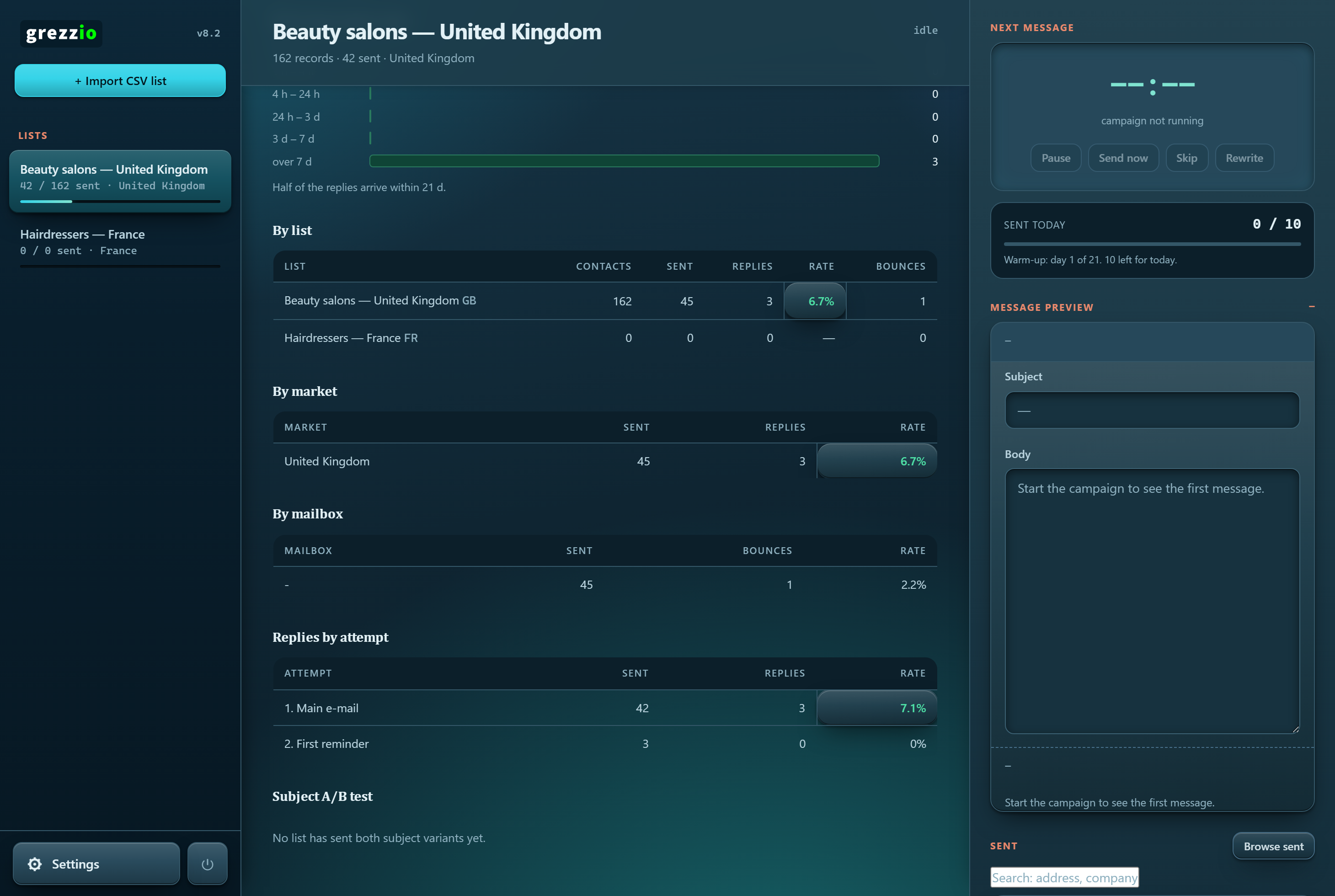
Replies split by attempt: the main e-mail and each reminder counted separately.
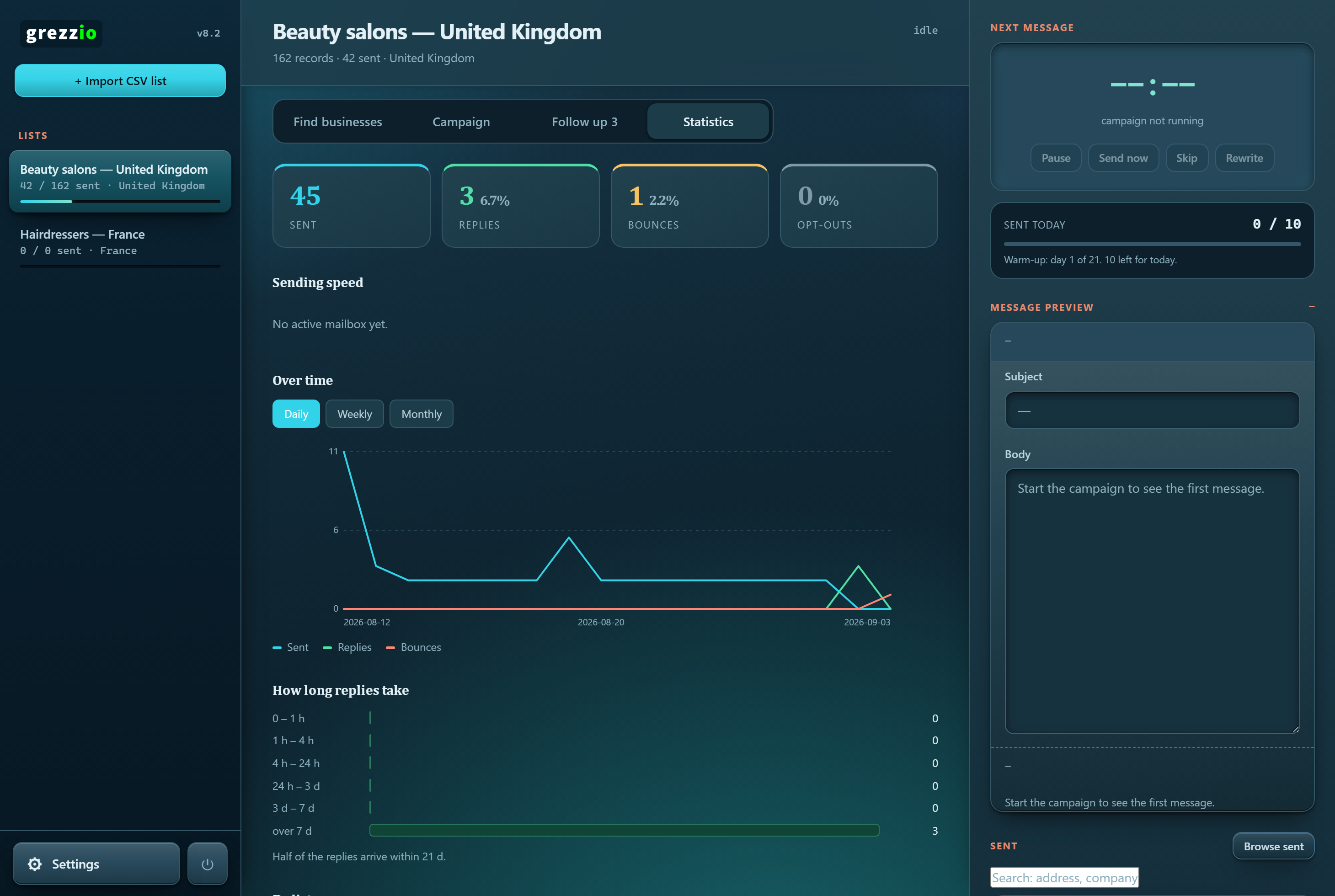
The Statistics tab: what a campaign actually produced.
05 / Custody
Not as a promise in a policy document. As an architecture: there is no server of ours for your data to travel to.
The internal server is reachable from your machine and nowhere else, behind a random access key generated fresh on every start.
SMTP passwords and your AI key are sealed with Windows DPAPI. The database file copied to another computer is useless.
Daily on start, always before a format change, always before a restore — written through SQLite's own API, so a backup can never catch the database mid-write.
Who, when, which market, on what legal basis, from which source, and what happened next — any period, one click, in the encoding Excel needs for accented text.
Migrations run in order with a backup before the first one, and a database from a newer version refuses to open instead of corrupting quietly.
There is nothing to log into and nothing to cancel. The program runs from your own folder, and your data is a single file you can copy.
06 / Licence
Each seat is its own local install with its own local database. Grezzio does not share one database across a team, by design.
€99 one-time
€279 one-time
Handled securely by Gumroad · prices exclude VAT, added at checkout at your country’s rate · licence key by e-mail immediately after purchase
07 / Questions
From Overture Maps Foundation, an open dataset backed by Meta, Microsoft, Amazon and TomTom. Grezzio reads it directly. The place index that ships with the program is built from the same source and carries the licences it requires — see data sources.
No. Nothing is harvested from Google Maps or from websites behind a login. Grezzio queries an open dataset that is published for exactly this kind of use.
Overture publishes a new release roughly once a month and Grezzio picks it up on its own. In September 2026 the supplier removed the column the program filtered on. Grezzio now asks the data which columns exist rather than trusting a calendar, so the change passed without anyone reinstalling anything.
Finding places does — the index is on your disk. Reading company data from Overture, sending mail and fetching replies all need a connection, as you would expect.
Through your own mailbox, over IMAP, with the credentials you already gave it for sending. The same connection that catches opt-outs and bounces now stores the reply itself.
Nothing is forwarded anywhere. The reply is read from your mailbox and written into the database on your disk.
Yes, because it is one. Grezzio stamps every outgoing message with its own identifier and threads the reminder to it, so in the recipient's mailbox the two sit together.
A bare “Re:” in the subject line with no threading headers is a separate e-mail pretending to be part of a conversation that never happened. The program will not do that.
Two at the most, and one by default. The ceiling cannot be raised from the window or through any setting.
This is not a whim. The legal basis for cold outreach is legitimate interest, and its weight falls with every unanswered message. At a third attempt the argument stops holding.
A reply, a bounce, an opt-out, a deleted contact, a stopped campaign, or a market that requires consent. Every one of those is checked immediately before sending, not only when the reminder was scheduled — days pass in between.
Only if you let it, and by default only for a refusal. The draft sits in the thread and waits for you to press send.
There is no switch that sends without asking. Until 8.1 there was one, off by default, and 8.1 removed it: a switch that exists gets turned on one day to see what it does, and by then the message has left your computer in your name. A draft costs one click.
Because without it the model can tell that a reply is a refusal but has nothing to write an answer from. Rather than produce something vague, Grezzio keeps drafts unavailable until you describe your work in a few sentences.
That description goes to the AI provider you chose and nowhere else.
It is stored and shown, and the thread turns blue: come back to this one later. It is never counted as a reply — an automatic answer in the reply rate inflates the only number by which a campaign is judged.
No. On first start 8.0 builds a thread for every contact you have already written to, so the tab opens with your history rather than an empty page.
The replies from before 8.0 are a different matter: the program did not store their content back then, so they are shown as a count and deliberately not attributed to any attempt.
No. Grezzio sends through your normal mailbox over SMTP — the same account you use in Outlook or on your phone. It works with Google Workspace, Microsoft 365, and ordinary hosting.
You decide, within reason. A new mailbox starts at 10 a day and climbs over three weeks; the ceiling is yours to set and 50 is the default.
The limit is per mailbox. Two mailboxes on the same domain are still one domain reputation, and the program says so when you add the second.
The campaign pauses itself once the bounce rate crosses your threshold over a meaningful sample. Addresses are checked before they are used, so most bad ones never reach the queue at all.
Yes, if you want the mail to arrive. It takes three DNS records and about ten minutes; the support page walks through it for the common hosts and Grezzio checks your domain for you.
Yes. €99 for one workstation, €279 for up to ten. No renewal, no per-message fee, nothing to cancel.
Every update on the releases page, including updates to the market rules as laws change. There is no separate maintenance fee.
No. Personalisation and reply reading are optional and use your own key with Anthropic, OpenAI or Google, billed by them directly. Without a key Grezzio sends the plain template and shows replies without a description.
Yes — 150 messages, everything else unrestricted. The trial keeps its own record of what it used, so reinstalling does not reset the count.
This is digital content delivered immediately at your explicit request, so the EU withdrawal right does not apply once delivery has begun. Requests outside that exception are considered case by case — write to us. Full detail in the terms.
Not today. Grezzio is a Windows application, and the encryption of your passwords uses a Windows facility directly.
In one file next to the program, called Grezzio Database.db. You can copy it, back it up and move it between machines. The program keeps seven daily backups beside it.
Nothing is stored anywhere else. There is no account and no server of ours in the path.
That depends on where your recipient is, which is the entire point of the program. Three markets allow B2B outreach without prior consent, sixteen allow it conditionally, thirty-four require an opt-in. Grezzio shows which is which and blocks the ones that need approval.
The rule set is updated as part of the licence, at no extra cost, and the program tells you how old the current one is.
We would like to use the Meta pixel to see which adverts bring people here. It only starts if you agree, and it is not needed for the site to work. Privacy policy